
How to Read and Understand Marriage Bonds
By Katharine Andrew
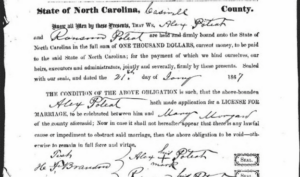
A marriage bond filed in North Carolina.
Have you ever come across a record called a “marriage bond”? You may associate bonds with getting bailed out of jail. But despite the name, marriage bonds don’t mean your ancestors got arrested right before their wedding.
Marriage bonds are not criminal records. Instead they were financial agreements tied to the legal process of getting married. They were common in the United Kingdom, Canada and many parts of the early United States.
For genealogists, these records can contain far more than possible evidence of a marriage. Marriage bonds can help identify relatives, close associates and more. Understanding the different parts of a marriage bond can help you uncover clues about your ancestors that might otherwise be overlooked.
Celebrate your ancestors’ love by recording the day they started a life together on this free marriage index worksheet.
Till Debt Do Us Part: What Are Marriage Bonds?
To understand marriage bonds, it first helps to understand what a “bond” is. A bond is a legal and financial agreement in which one or more people pledge money as a guarantee that a certain obligation will be fulfilled. If the terms of the agreement are broken, then the money is forfeited. Bonds appeared in many areas of early American life and law (and still do today): court cases, apprenticeships, guardianships and, of course, marriages.
A marriage bond, filed with a local government, acted as a financial guarantee that there was no lawful reason for the marriage not to take place. If it later surfaced that one or both of the individuals was already married, underage without consent, too closely related, or legally unable to marry for another reason, the bond amount could be collected.
While genealogists often use marriage bonds as evidence of a marriage, they are not a marriage record because they were filed before a wedding occurred. Bond records are secondary evidence; they only confirm that a bond was filed, not that the ceremony actually occurred.
In many cases, the groom and another person signed the document together. That cosigner was a bondsman, often the groom’s relative, close friend or neighbor, or a relative of the bride. Because communities in the early years of the U.S. were often small and interconnected, it’s important to pay attention to who the bondsman was because this person can provide valuable genealogical clues about family relationships, migration groups or FAN club connections.
Marriage bonds were especially common in the Southern and Mid-Atlantic region of the US during the 18th and 19th centuries, especially in North Carolina, Virginia, Tennessee and Kentucky. In some regions, they were an alternative to marriage banns–public church announcements made before a marriage took place. Laws around marriage bonds vary depending on the colony or state and time period.
What You Can Find in Marriage Bonds
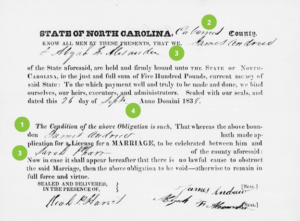
Marriage bond for James Andrew and Sarah Pharr
Citation:“Cabarrus, North Carolina, United States records,” database, FamilySearch (https://www.familysearch.org/ark:/61903/3:1:3Q9M-CS44-D988-D : 2026), Image Group Number 102155806 > image 115 of 1090, marriage bond for James Andrew and Sarah Pharr, 26 September 1838, Cabarrus County; imaged from North Carolina State Archives, unnumbered microfilm labeled “Marriage Bonds Acock – Atikisson, 1792-1868.
- Conditions and fine
A man would file a marriage bond to legally state his intention to marry a specific woman and confirm there was no legal impediment to the marriage. Look for the words “firmly bound,” “sum of [amount of money],” “condition of the above obligation,” and “bounded.” These words and phrases distinguish a marriage bond from other types of marriage records.
Don’t confuse a marriage bond with a marriage license. While it was common for a marriage license to be filed at the same time that a bond was signed, they are two separate types of documents.
An amount of money (the stated fine) also distinguishes marriage bonds from other types of marriage records. In this case, the fine was a sum of North Carolina pounds. Note that this is not denoting a British pound (Pound Sterling). At the time, North Carolina’s local currency was called the “pound.”
- Location
Cabarrus County, N.C. is where this bond was filed in court. This is where the marriage was planned to occur. Use this location to search for all the individuals named in the document for census records, marriage licenses and returns, and other kinds of records.
- Named parties
A marriage bond names the bond applicant (the groom in most cases), as well as another party committing themselves to the bond (bondsmen). Bondsmen are often relatives of the groom or future in-laws. Look for records that can connect them.
- Dates
Under most circumstances, the marriage itself took place after the bond was filed in court. In this case, the bond is dated 26 September 1838.
This article was published online in May 2026. A similar article by George G. Morgan appeared in the October/November 2018 issue of Family Tree Magazine.