
Elephind 2.0: Search Free Newspaper Collections on Elephind
By Katharine Andrew
Officially released in late September 2025, Elephind 2.0 is now live! It is brought to you by Veridian Software, one of Family Tree Magazine’s 101 Best Genealogy Websites of 2025.
Elephind was originally launched in 2012 as a search engine for newspapers across multiple sites. At its height in 2021, 3,600,000 newspapers were searchable on the website. But it was taken offline in 2023 due to the unsustainable cost of hosting and maintaining the site. However, due to popular demand, Veridian Software (developed by DL Consulting) has brought the website is back, with a different model and new technology. Read on to learn how you can search multiple free newspaper collections on Elephind 2.0.
What is Elephind?
Elephind is a search engine specially designed to help people discover historical newspapers from digitized collections around the world. The tool searches multiple collections at once, allowing you to efficiently comb the holdings of multiple libraries, universities, and other cultural institutions.
The site’s developer, Veridian, also operates the platform that is used by many partner organizations to host their digital newspaper collections. According to the “About” page, “The newspaper items indexed by Elephind remain the property of the libraries, universities, and cultural institutions that digitised them. Our role is to help people discover and access this content more easily.”
What are the newspaper collections on Elephind?
As of writing (September 2025), Elephind is already able to search 13,769,643 pages of historical newspapers. The site plans to add another 15 million pages within the next month and 15 million more by the end of the year. According to the header on the website, it appears that there are 150+ million pages in queue for inclusion in the search engine.
Those pages comes from more than 1,600 newspaper titles at 24 organizations from across the United States. You can view an alphabetical list of what titles included under the “Newspaper Collections” page on the site.
Remember: Even with millions of pages, Elephind coverage is not exhaustive and does not cover the entire U.S. Newspapers will be added over time, but many places are not yet represented on the website.
To give a sense of the site’s coverage, here are the institutions that have contributed the largest collections searchable on the site:
- Colorado Historic Newspapers Collection: 337 titles and 1.6+ million pages
- Digital Michigan Newspapers: 175 titles and 1.25+ million pages
- NYS Historic Newspapers: 257 titles and 3.3+ million pages
- The Catholic News Archive (CRRA): 29 titles and 916k+ pages
- Virginia Chronicle: 556 titles and 3.7+ million pages
- Washington Digital Newspapers: 115 titles and 887k+ pages
Elephind gives you two ways to search newspapers:
- Keyword Search: Finds only the exact words that you type
- Smart Search: Interprets the broader meaning of the phrase you search by looking for synonyms, related concepts and context
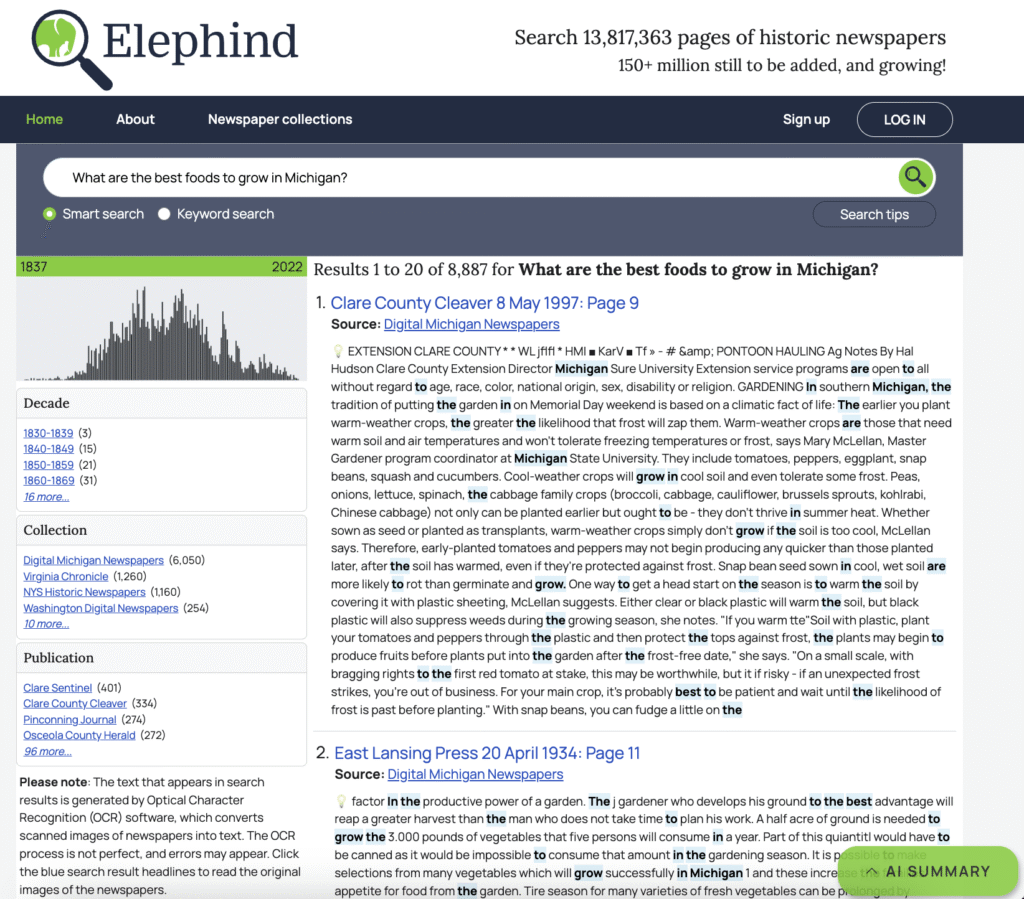
This means that, unlike other historical newspaper websites, you do not have to limit yourself to specific or short keywords or phrases. You can enter full questions or phrases. For example, try How was beer brewed in Virginia in the 1600s? to uncover articles on brewing history. One result is an 1869 Daily Dispatch article (via the Virginia Chronicle) about the James River Steam Brewery—then owned by David G. Yuengling Jr., son of the founder of D. G. Yuengling & Son.
Other questions that resulted in good answers include When was baseball invented?, What churches were built in Cleveland during the 1880s?, or How did influenza affect Detroit in 1918? Even if the newspapers used different wording, Smart Search will attempt to connect you to relevant articles. If your results aren’t helpful, try rephrasing the question.
Elephind also bridges modern language with historical context. For example, a search for WWI soldier illnesses returns references to 1910s illnesses caused by the conflict—even though the term “World War I” was used.
Once you’ve run a search, you can filter results by date range, collection or publication title. By using these filters, you can also explore how coverage and public opinion shifted over time: for example, a question like What are the best foods to grow in Michigan? will give you different answers advice depending on whether you look at the 1910s or 2000s.
Elephind’s “Search Tips” page also recommends searching across languages. Searches can “return relevant newspapers in other languages, such as Spanish, even if your query is in English. For now the majority of the newspapers searched by Elephind are English, but this will change in time.”
TIP: When you click through to the hosting archive, you will need to use that website’s tools to download and clip the newspaper. (Also for your citations—cite that website, not Elephind!)
AI Summary Assistant
After performing a search, click the AI Summary button on the bottom-right corner of the results page. This tool quickly summarizes or extracts key information from the first 20 results.
When using the tool, you can give the built-in chatbot follow-up commands, such as “Summarize the retrieved newspapers” and “Elaborate on the broad topics described in the retrieved newspapers.”
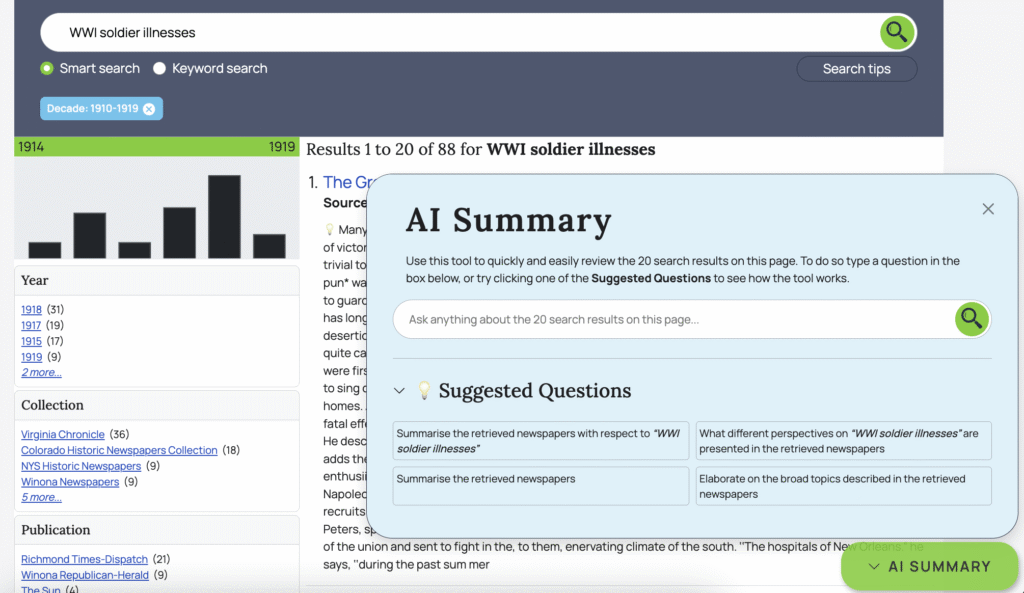
Keep in mind, however, that this feature is meant to complement Elephind’s main search, not replace it. Also, as with any AI chatbot, always double-check the facts and read the actual articles that it is citing. Summaries can be tripped up by OCR errors or occasionally “hallucinate” details that aren’t in the source text.
Though, on that point, on Elephind’s “About” page, the team writes that they are committed to “safeguarding content from misuse, including helping ensure it’s not repurposed by AI models in ways that could distort the historical record.”
Pricing
This early, “experimental” version of Elephind is free to use (as was Elephind 1.0). However, according to the company, “Our intention … is to soon move to a subscription model, where users will be able to make a limited number of searches each day for free, but will need to subscribe and pay a small fee for unlimited access.” Subscription fees will help cover the behind-the-scenes costs of creating, hosting and updating the website—the very things that lead to Elephind 1.0’s closure.
As of writing, you can join on three separate levels, one of them free:
- Supporter (free): Gives you email notifications about new features and when new newspapers are added.
- Sustainer ($10/month): Gives you everything is Supporter and directly supports the operations—or, according to the site, “Help keep the lights on and the service running strong.”
- Accelerator ($20/month): Gives you everything in Supporter and Sustainer, and helps accelerate the addition of more newspapers.
This article was posted online on 26 September 2025
Reprinted with permission from Family Tree Magazine