
Gravestone Symbols and
Their Hidden Meanings
By Joy Neighbors
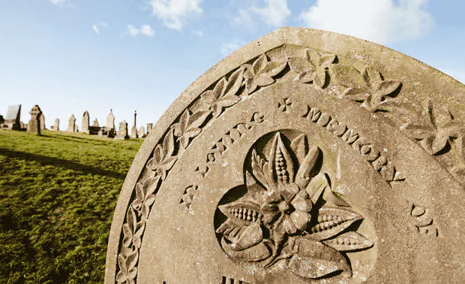
A gravestone decorated with carvings of flowers and plants. Courtesy of Getty Images.
For thousands of years, symbols have been carved on cave walls, formed into religious icons, and etched onto buildings and monuments. They provide a visual representation of personal sentiments and cultural values. They were added to tombstones, too, providing some insights into the lives of the departed.
In the United States, Puritans included icons that were far from uplifting in their graveyards: death’s heads, skulls and crossbones, and scythes. All were reminders of earthly mortality—and sharp nudges to the living to have chaste, faithful lives.
Later Colonial graves expanded icons to include willow trees, flowers and subtle religious imagery, meant to offer comfort and a more pleasant view of death. Throughout the 19th century, though, Victorians used a more-secret language in cemetery icons. Symbols told stories and reflected sentimentality, a fascination with death, and a desire for mystery and intrigue.
Today, cemeteries present an even wider array of symbols: those representing life, death and rebirth along with carvings related to personal interests. Below you can learn what some of the most-common tombstone symbols mean. Along the way, you’ll see several examples from graveyards. Some icons have multiple possible interpretations—look for details in parentheses.
Today, cemeteries present an even wider array of symbols: those representing life, death and rebirth along with carvings related to personal interests. Below you can learn what some of the most-common tombstone symbols mean. Some icons have multiple possible interpretations—look for details in parentheses.
A word of caution before we get started, though: tombstone scholars still debate the meanings of certain symbols, so you could find varying interpretations. Don’t forget to grab your free download to common tombstone symbols before you head out on your next research trip!
Gravestone Symbols and Their Meanings
| Symbol | Meaning |
| Arches and gates | passage into the next life |
| Acorn | prosperity and immortality, promising new life and new potential |
| Anchor | hope, stability and/or steadfast faith in times of persecution; occupation as a sailor, fisherman or other mariner, Navy |
| Angels | sorrow or mourning; delivery to the afterlife; innocence or purity (cherubs); the second coming of Christ on Judgment Day (e.g., Archangel Gabriel blowing a horn) or hope for heaven (angels pointing up) |
| Animal | occupation such as farmer (cows, horses, sheep, chickens), fisherman (fish) or butcher (cows, pigs, chickens) |
| Anvil and/or hammer | blacksmith |
| Baby | loss of an infant or young child |
| Basket | nurturing, maternal bond; abundance and a full, fruitful life |
| Bat wings | death; misfortune |
| Beehive | possible membership with the Independent Order of Odd Fellows, or the Church of Jesus Christ of Latter-day Saints |
| Benches | mourning; contemplation |
| Bird | flight of the soul |
| Book | the seeking knowledge or faith; occupation as an educator, teacher, lawyer or (if a Bible) minister |
| Bone | death |
| Candle | faith or promise of eternal life; the journey to the afterlife |
| Cannon/Cannonball | power or defense, especially during battles; military service |
| Cat | an independent spirit; guardian or companion |
| Chains | membership in the Independent Order of Odd Fellows; freedom from oppression (when broken) |
| Chair or Stool | absence of a loved one (when empty) |
| Chalice | in Christianity, Holy Communion and/or the blood of Christ; in Wiccan and Neopaganism, feminine qualities such as motherhood and intuition |
| Church | ministry; possible pastor or minster |
| Clock | time passing/the inevitability of death; possibly, the person’s time of death |
| Clover (three- or four-leafed) | Christian trinity; possible Irish ancestry or affiliation with 4H Club |
| Column and/or pillar (Broken) | life cut down in its prime (when broken) |
| Column and/or pillar (Unbroken) | a complete and full life |
| Compass (with a square) | membership in the Freemasons |
| Corn | farming (also frequently symbolized by wheat) |
| Cradle/clamshell | loss of a child |
| Crescent moon | Islamic faith; divine power and growth; membership in the Shriners |
| Cross | Christian faith; religious denomination such as Catholicism (crucifix) or Eastern Orthodox (Greek cross); eternal life/victory over death; occupation of minister; membership in the Knights Templar or the Freemasons (flared cross or cross with crown) |
| Dog | guardian or companion (especially “fu dogs,” grave symbols in Chinese culture); devotion, love and loyalty; vigilance |
| Door | transition to another realm; the boundary between life and the unknown |
| Doves | hope; peace; purity; the Holy Spirit; ascension to heaven; loss of a child; occupation as minister |
| Elk | possible membership with the Benevolent and Protective Order of Elks |
| Evergreen | faithfulness; remembrance |
| Eye | watchfulness/awareness; divine protection and power; membership in the Freemasons (the “all-seeing eye”) |
| Feathered headdress | possible membership with the Improved Order of Red Men or Degree of Pocahontas |
| Fern | sincerity; humility; solitude |
| Fish | occupation as a fisherman; Christian faith |
| Flag | US military service, especially a draped flag (indicating death in service) |
| Flame | vitality; life extinguished (when turned down) |
| Flower | Gratitude and remembrance/hope for eternal peace (bell flowers), marriage/delity (Calla Lilies, Easter lilies, Madonna lilies); rebirth/new beginnings (daffodils); joyfulness, hope and love (daisies); sweetness, humility and hope (Lilies of the Valley); Lily, Madonna or Easter); Fragility of life/loss of a young person (morning glories); life ending in its prime, in its youth, or before it had a chance to “bloom” (roses). |
| Forefinger pointing down | God reaching down for the soul |
| Forefinger pointing up | soul’s passage to Heaven |
| Fruit | eternal plenty |
| Grapes | abundance/prosperity |
| Gun | military service or otherwise fighting for one’s country |
| Half-carved tombstone | transition from life to death |
| Hand | faith/spiritual beliefs (especially when praying); unity and bidding farewell/a married couple (when clasped); the soul’s ascension to Heaven/God’s hand reaching down (when pointing up or down); acceptance into afterlife (when palms are open |
| Handshake | welcoming of a soul into Heaven; bond between spouses (if hands are feminine and masculine) |
| Harp | worship; music to God |
| Heart | eternal love; grief/tragic loss when broken); Christ’s love and sacrifice (Sacred Heart, a heart on re) |
| Horses | courage or generosity; possible membership with the International Brotherhood of Teamsters (especially if two-headed) |
| Hourglass or clock | the passage of time |
| Indian imagery | Membership in the Improved Order of Redmen (headdress, tomahawk, wigwam,council fire, etc.) |
| Ivy | fidelity/ undying affection; eternal life |
| Key | knowledge; entrance to heaven |
| Knight helmet and/or armor | membership in the Modern Knights Templar or the Knights of Pythias |
| Lambs | purity; gentleness; innocence; popular on children’s graves |
| Lamp | knowledge; spiritual immortality |
| Laurel leaf | immortality/victory over death; significant achievement; membership in the General Society of Mayflower Descendants |
| Leaf | strength/stability and honor (oak leaves); endurance/overcoming adversity (acanthus); triumph/eternal life/martyrdom and peace (palm fronds); eternal love (philodendron leaves in heart shape) |
| Lily | innocence and purity; resurrection; marriage and fidelity (Calla); innocence and humility (Lily of the Valley) |
| Lion | courage/bravery; power; guarding a grave (when in a pair) |
| Mallet or wedge | occupation as a blacksmith or carpenter; membership in the Modern Woodmen of America or Woodmen of the World |
| Man with rope and/or holding an hourglass | grim Reaper or Father Time escorting the deceased to the afterlife |
| Mariner | anchor; sextant |
| Medal | military honors |
| Menorah | symbol of Jewish faith and/or Israel’s role as light unto the nations |
| Mortar and pestle | medical profession (pharmacist or doctor) |
| Oak leaf | strength; stability; endurance |
| Olive tree | peace; reconciliation between God and man |
| Palm | life conquering death; resurrection |
| Phoenix | resurrection |
| Pineapple | prosperity; hospitality; perfection |
| Pyramid | journey to another realm; membership in Shriners International |
| Rose | love; beauty; virtue; motherhood; strong bond (intertwined); youthful death (rosebud) |
| Scales | justice; law; occupation as a lawyer or judge |
| Scroll | Sacred writings; the story of the deceased’s life; membership in the General Society of Mayflower Descendants |
| Seal of a military branch | Service in the Army, Navy, Marines, Air Force, etc. |
| Shield | protection, faith, defense of the spirit |
| Ship | life’s journey; occupation as a fisherman or mariner; membership in the General Society of Mayflower Descendants |
| Shoes | (empty, one overturned) loss of a child |
| Skull | fleeting nature of life; journey to afterlife (with wings) |
| Soul effigy | immortality of the soul; passage to the afterlife (especially if winged) |
| Sphinx | wisdom; protection; honor; membership in Shriners International; guarding a grave (especially when in pairs) |
| Star of David | Jewish faith; God’s protection of the Jewish people |
| Sword | Bravery/valor; military service or death in battle (when crossed); membership in the Knights of Pythias |
| Thistle | sorrow and remembrance; potential Scottish ancestry |
| Three steps | The Holy Trinity in Christianity (Father, Sun, Holy Spirit); the three Christian virtues of faith, hope and charity |
| Tool | Occupation as a blacksmith, carpenter, miner, farmer, etc.; membership in a trade organization or the Modern Woodmen of America |
| Tree | Life; wisdom/knowledge with “roots’ across generations; life cut short or sudden loss (with broken or missing branches); mourning and sorrow (when willow trees); membership in the Modern Woodmen of America or Woodmen of the World (tree stone) |
| Urn | Container for the soul; the separation of life and death (when draped) |
| Veil | boundary between the physical world and the afterlife |
| Vines | Unity/connection that can’t be broken |
| Virtues | various theological or civic values (above: three women representing faith, hope and charity) |
| Water | flow of life; renewal/purification; mysterious depths to unknown regions |
| Well | vessel for the soul; mysterious depths to unknown region |
| Wheat | long and fruitful life/full harvest that’s been gathered; occupation as a farmer |
| Wheel | membership in the Daughters of the American Revolution; the end of life’s journey or a break in the family circle (when broken |
| Winged death’s head | mortal remains of the deceased |
| Willow | mourning and earthly sorrow |
| Woman | sorrow/mourning and reverence (when bowing head); faith and hope (when holding a cross); life’s fragility (when scattering pedals); death in childbirth (when holding a baby) |
Headstone Initials and Acronyms
| Initials | Meaning/Affiliation |
| A Ω | Alpha and Omega, the first and last symbols of the Greek alphabet used in the Book of Revelation to describe God |
| AAONMS | Ancient Arabic Order of the Nobles of the Mystic Shrine (Masonic) |
| AASR | Ancient and Accepted Scottish Rite (Masonic) |
| BPOE | Benevolent and Protective Order of Elks |
| CSA | Confederate States of America |
| DAR | Daughters of the American Revolution |
| FCB | “Friendship, Charity, Benevolence,” the motto of Knights of Pythias and the Independent Order of Odd Fellows |
| FOE | Fraternal Order of Eagles |
| G in square with compass | Freemasonry |
| GAR | Grand Army of the Republic |
| IHC/HIS | Christian; the first three letters of Jesus’ name in Greek |
| IOOF | Independent Order of Odd Fellows |
| K of C | Knights of Columbus (Catholic) |
| K of P | Knights of Pythias |
| LOM | Loyal Order of the Moose |
| MWA | Modern Woodmen of America |
| SAR | Sons of the American Revolution |
| VFW | Veterans of Foreign Wars |
| WCTU | Women’s Christian Temperance Union |
| WOW | Woodmen of the World |
Changing Meanings
NOTE: Some content contributed by former digital editor Courtney Henderson.
If you have pictures of tombstones from different parts of the country, you’ll notice regional symbols that evolved as attitudes toward death changed. For instance, the winged death head (a skull with wings), most commonly seen on the graves of New England colonists, is one of the earliest cemetery art forms in America. The Puritans viewed death in its stark reality: It was part of their daily lives, and they believed their salvation was never certain. They had little regard for physical remains, and hastily buried loved ones with minimal ceremony. Although the Puritans grieved privately, they deemed public expressions of sadness inappropriate.
Harriette Merrifield Forbes, author of Gravestones of Early New England, and the Men Who Made Them, 1653-1800, has grouped Colonial and early American symbols from New England into five categories, according to their significance:
-
- recognition of the flight of time
- the certainty of death and warnings to the living
- the occupation of the deceased or his station in life
- the Christian life
- the resurrection of the body and the activities of the redeemed soul
Beginning in the early 1800s, Americans replaced the winged death head with symbols of mourning, hope and resurrection, as represented by the winged cherub, soul effigy, willows and urns. This transition no doubt stemmed from the Great Awakening revivals of the 1730s and 1740s. The old Calvinistic beliefs of predestination and damnation died, and notions of salvation through good deeds and divine grace took their place. Also during this period, people viewed the deceased as resting in a state of eternal sleep, so they adorned their loved ones’ graves with carved drapery, pillows, chairs, beds, flowers and other objects that would comfort them.
Headstone Materials
By determining the headstone’s composition, you can tell if the marker at your ancestor’s grave is the original or a replacement. Before the 1650s, people used mostly fieldstones or rough-cut rocks to mark graves. A stone from this time might have the deceased’s initials and death year carved on it. From about the 1660s to 1850s, headstones consisted of sedimentary rock, such as red or brown sandstone or limestone, and dark slate. You’ll also see early 1800s gravestones made from a grayish-blue slate. Marble was the stone of choice between the 1830s and 1880s. Since the 1880s, we’ve stuck with granite headstones. That means a granite stone with a pre-1880 death date isn’t the original marker.
A Note on Grave Epitaphs
Epitaphs are short verses or poems written to honor a deceased person, and they are frequently seen on gravestones.
Epitaphs typically reflect living relatives’ feelings toward the deceased, as survivors would select verses from monument makers’ and funeral directors’ catalogs. Occasionally, people would specify what they wanted on their tombstones—such pre-selected epitaphs tend to reflect the decedents’ personalities.
Like funerary art, epitaphs carved on gravestones reveal changing outlooks on death. Colonial verses were meant to provide instruction, not comfort. Here’s a common warning to the living:
Stranger, stop and cast an eye,
As you are now, so once was I,
As I am now, so you shall be,
Prepare for death and follow me.
Generally, families have derived epitaphs from popular or favorite poems, other classic literary works such as Shakespeare, and holy scriptures or prayers. As Americans came to favor more-comforting verses, scripture passages and prayers for mercy became the most common types of epitaphs.
A version of this article was posted online in February 2019, and a version also appeared in the September/October 2025 issue of Family Tree Magazine. Last Updated: October 2025